
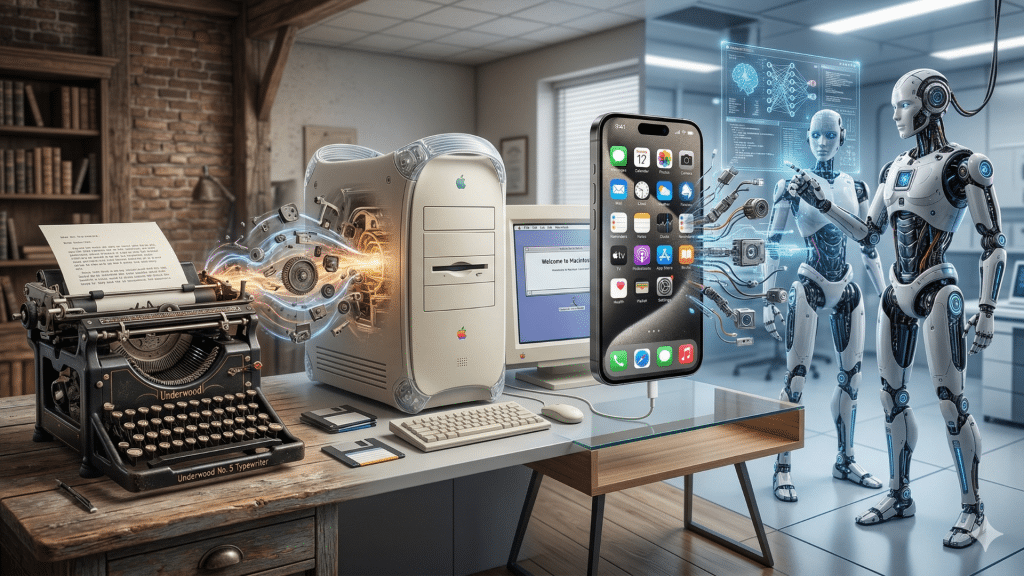
Will AI Replace Humans? Why We Still Need a Human in the Loop
Have you ever wondered if people were afraid when the typewriter was replaced by computers?
I thought about that when I recently remembered my typewriting class in high school. For two years, we practiced the rhythm of the keys, increasing our speed and accuracy. Then suddenly when I started my junior year, the class changed. It wasn’t called typewriting anymore. It became keyboarding, and the typewriters were replaced by beige Macintosh towers with floppy drives.
During that time, the transition felt significant to many because it represented a shift in how work would be done. Businesses were beginning to move away from paper-based systems and into the world of digital computing. Looking back, it was one of the early signals to me about how the workplace evolves.
People didn’t stop working when typewriters disappeared, unless they were unwilling to use a keyboard. Their work simply changed as new tools became available. The skill of typing still mattered, yet the environment around it expanded into word processors, spreadsheets, and digital communication. The tool changed, but the human role adapted.
A similar shift is happening today with artificial intelligence. The technology is new, the tools are powerful, and the conversation is moving quickly. Some people are excited about the possibilities, while others are concerned about what this means for their future.

My First Experience With AI (Before ChatGPT)
A couple of years before ChatGPT became widely available, I began experimenting with an AI marketing tool called Jarvis, which many people know as Jasper today. Curiosity drove my experimenting, because I wanted to understand whether AI could help speed up certain parts of the content creation process. Marketing involves a lot of thinking, writing, and organizing ideas, so the possibility of assistance was intriguing.
During those early tests, a pattern appeared quickly. The quality of the results depended heavily on the questions being asked. When the prompts lacked clarity, the responses felt generic and unfocused. When the direction was more specific, the tool became much more helpful.
This revealed an important insight: using AI effectively required learning how to ask better questions. The process was less about mastering a tool and more about sharpening the thinking behind the prompts. Clear questions create clear direction, and clear direction produces better outcomes.
Experience plays a significant role in this process. Someone who understands a craft, whether that craft is marketing, development, writing, design or most anything else can guide the tool much more effectively in what they need from it. All our personal experiences and skills equip us to recognize what matters, identify gaps, and refine the direction of the conversation. This is where the concept of Human in the Loop begins to take shape. (More on that a little later!)
Some of the most valuable questions in those early experiments were not directed at the tool itself. They were directed inward toward the strategy behind the work. Questions such as why the tool should be used, where it could genuinely help, and where human judgment should remain central became part of the learning process.
The Growing Trust Challenge
I’m sure you’ve noticed another pattern emerging on social media platforms- AI videos and images that are becoming nearly impossible to differentiate from real content. People are beginning to ask another question: Is this real?
When people struggle to distinguish between authentic human expression and automated output, trust becomes more fragile. Digital platforms already face credibility challenges, and the rapid expansion of AI-generated content introduces new uncertainty.
This tension is producing an interesting shift in perception. The more automated the internet becomes, the more people begin valuing genuine human presence. Automation increases speed and scale, yet human connection builds trust.
Technology certainly reshapes how some types of work are done. The printing press changed communication, computers transformed offices, and the internet reshaped marketing and media. Artificial intelligence is now influencing how we research, write, analyze information, and create ideas. I think the most valuable question we can ask is not whether work will change- work is already changing, and always has been. A more valuable question that will get you moving in the right direction is:
What will we do with the time AI gives us back?
What “Human in the Loop” Really Means
The phrase Human in the Loop describes a simple but powerful principle. Artificial intelligence can assist with generating ideas, processing data, and accelerating tasks, but humans remain responsible for guiding the outcome. Human judgment provides the context and meaning that technology cannot replicate on its own.
Human involvement introduces perspective, ethics, creativity, and empathy into the process. These elements emerge from lived experience, not algorithms. When human insight remains present, AI becomes a collaborative partner rather than a replacement.
This approach already appears across multiple industries. Marketing teams use AI to explore ideas while maintaining strategic direction. Developers rely on AI tools to accelerate coding tasks while still making final decisions about structure and quality. Healthcare professionals analyze data with AI support while retaining responsibility for diagnosis and care.
This is an important pattern: AI assists while humans lead. When we remove the ‘human in the loop,’ we risk allowing AI hallucinations to become the foundation we build on.
Think About This
Artificial intelligence introduces a powerful opportunity that extends beyond simple automation. The true opportunity lies in reallocation. When routine tasks require less time, leaders and teams gain the freedom to invest attention where it matters most.
That time can strengthen relationships, expand creative thinking, and deepen conversations that build trust within communities. Work becomes less about output and more about creating meaningful impact. Technology was never meant to replace human connection. The greatest value of technology appears when it supports and amplifies it.
Final Reflection
Discussions about AI often focus on what might be lost as technology evolves. A more hopeful perspective considers what might be gained through thoughtful collaboration between people and tools. The more digital the world becomes, the more valuable authentic humanity becomes. Presence, empathy, creativity, and discernment remain qualities that technology cannot replace.
Keeping a human in the loop ensures that artificial intelligence remains what it was always meant to be: a tool that helps people connect, create, and serve others more effectively.
When technology gives us time back, the most meaningful investment we can make with that time is people.
This article is grounded in our own experiences, reflections, and insights. AI tools may assist with research or drafting, but every piece is reviewed, shaped, and published with human discernment.
Frequently Asked Questions
What Does “Human in the Loop” Mean in AI?
Human in the Loop (HITL) refers to a process where artificial intelligence assists with tasks while a human remains involved in guiding decisions and reviewing results. AI can analyze data, generate ideas, or draft content, but people provide context, judgment, and final direction.
This approach combines the speed of technology with human experience. AI helps accelerate work, while humans ensure the outcome is accurate, ethical, and meaningful.
Will AI Replace Human Jobs?
AI is more likely to change jobs rather than replace them entirely. Throughout history, new technologies have shifted the tools people use while creating new roles and opportunities.
Many repetitive tasks may become automated, but human strengths such as creativity, strategy, empathy, and relationship building remain essential. As AI evolves, the most valuable professionals will be those who learn how to collaborate with it.
Why Is Human Oversight Important in Artificial Intelligence?
Human oversight ensures that AI-generated results remain accurate, responsible, and aligned with real-world goals. AI systems can produce helpful insights, yet they can also make mistakes or lack important context.
When people review and guide AI outputs, they provide judgment, ethical awareness, and practical experience. This oversight helps organizations use AI effectively while maintaining trust with their audiences.
ℹ️ Please keep the comments free of promotions or sales pitches. Any comments containing such content may be marked as spam or edited before publishing.
You may also like








Together, Let's Transform Your Marketing
Clarity • Connection • Confidence

Schedule a
Discovery Call
Let’s discuss and uncover your biggest marketing challenges and goals.

Identify the Right
Support Path
Together, we’ll build a focused, message-driven marketing plan.

Move Forward
with Confidence
Implement the strategy and watch your brand connect and expand.